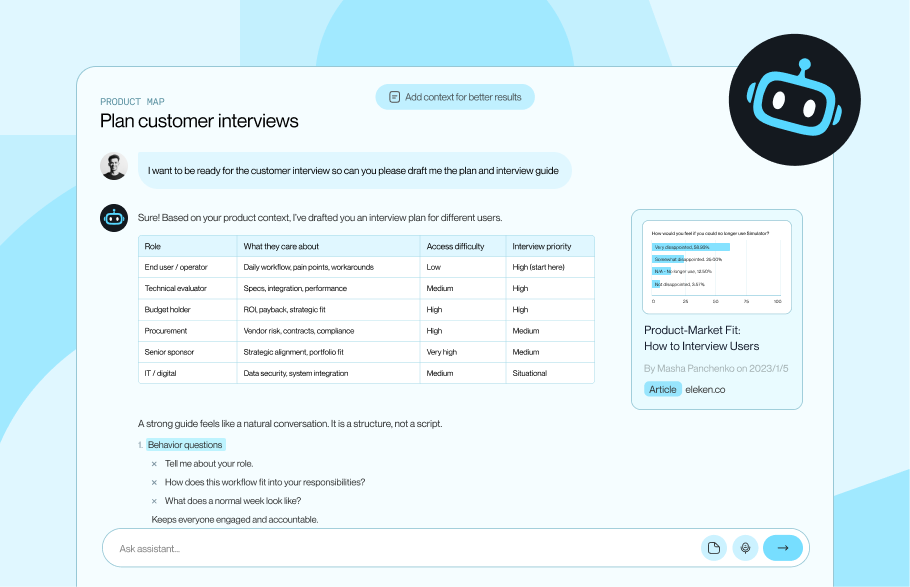



Needfinding interviews are exploratory conversations that help product managers understand how people behave today, what problems they face, what alternatives they use, and why those problems matter.
The goal is not to collect opinions about a feature idea. The goal is to find evidence that a problem is real, repeated, costly, and currently solved badly enough to deserve product attention.
Needfinding works best when the whole interview follows one principle: evidence over opinion.
Recent behavior is stronger than future prediction. A workaround is stronger than a compliment. A costly current process is stronger than "that sounds useful."
Evidence Hierarchy
Strong evidence includes a recent concrete story, a repeated workaround, money or time already spent, a failed attempt to solve the problem, a painful trade-off, or a decision that created real consequences.
Medium evidence includes detailed stories, emotional intensity, repeated language across similar participants, and a clear description of stakes.
Weak evidence includes generic opinions, feature wish lists, compliments, future promises, and "I would use that."
A useful interview rule is simple: talk about their life before you talk about your idea. The participant should speak most of the time. The product manager should set context, ask neutral questions, probe for detail, and listen for evidence.